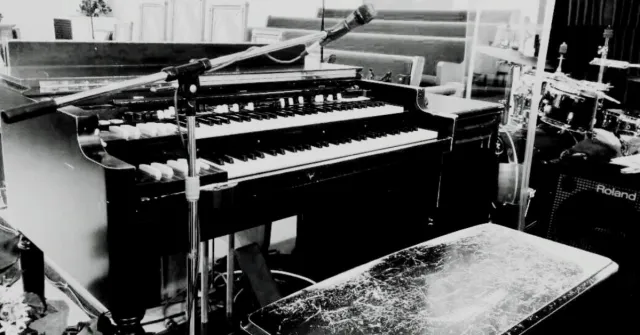
Few keyboards carry the grit, warmth, and soul of the Hammond organ. Its thick, resonant tones and signature vibrato have shaped everything from jazz and gospel to rock and modern experimental music. At Noise Machines, our Hammond L100 sits at the heart of the studio—a machine that turns every session into a performance, and every performance into a recording that breathes.
The Story Behind the Sound
The Hammond organ was born in the 1930s, when engineer Laurens Hammond sought a portable, affordable alternative to the pipe organ. What started as a practical invention quickly became a musical phenomenon. With its mechanical tonewheels and rich harmonics, the Hammond offered a palette of sounds that no piano or synth could match.
By the 50s and 60s, musicians had made it an essential part of jazz combos, rock bands, and studio sessions. Pair it with a rotating Leslie speaker, and you had a sound that could shimmer, swoop, and roar—all at the touch of the keys.
The L100 at Noise Machines
Our Hammond L100 may be compact compared to a B‑3, but it’s no less commanding. The drawbars let players sculpt their own harmonics, while the built-in vibrato adds motion and depth. Its tone fills the live room naturally, making it both a visual centerpiece and a sonic anchor.
Playing it is an experience in itself: the subtle hum of the tonewheels, the tactile drawbars, the way a chord seems to breathe—these are the little details that plugins can only hint at. Every note rewards touch, expression, and exploration.
Timeless Tone, Endless Possibilities
The Hammond has appeared on countless classic recordings—from Jimmy Smith’s smoky jazz runs to Deep Purple’s rock anthems, and even in modern soul and electronic productions. Its versatility is unmatched: it can provide lush pads, punchy rhythmic stabs, or soaring melodic lines.
At Noise Machines, we often pair it with a Leslie cabinet for that swirling, immersive effect, or patch it straight into the desk for a more immediate, raw sound. Each approach brings something different, giving the instrument a unique role in every session.
Why It Still Matters Today
Digital emulations are everywhere, but the L100 is tactile, unpredictable, and alive. The imperfection of real tonewheels, the physical feel of drawbars, the subtle shifts in resonance—these give it a life all its own. For producers and artists, it’s a tool for color, character, and emotion. It fills a track without overpowering it, and inspires ideas that might never emerge in a purely digital setup.
Come Play the L100
Want to bring some of that vintage character into your next recording? Experience the Hammond L100 firsthand at Noise Machines.
Contact Radi at radi@noisemachines.studio or 0405 709 131 to book a session.