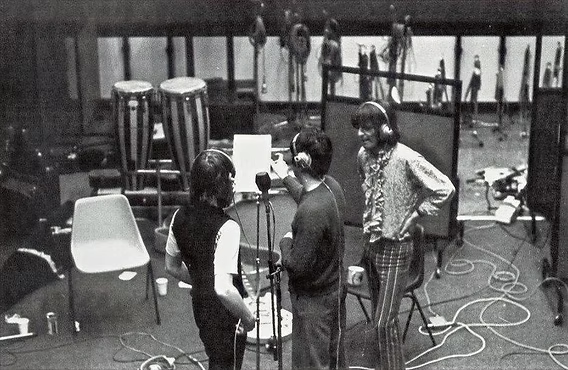
There’s usually a moment in a recording session where a take feels like it is working, even if it isn’t technically perfect. A vocal might sit slightly behind the beat, a guitar part might push forward in places, or a drum performance might feel a little looser than expected. The instinct in most cases is to fix it and try again.
Another take gets done, and then another. Small adjustments start to tighten things up. Timing gets corrected, pitch is refined, and performances become more controlled. On paper, everything is improving, but gradually the original feel of the performance can start to disappear as the focus shifts toward precision rather than intent.
There’s also a reason so many performances that defined the MTV era still feel alive today. They were polished enough to land on screen, but not so polished that the human energy disappeared.
The first take is less self-aware
In the early stages of a performance, there is usually less awareness of how it is being captured. The focus is on the idea itself rather than the recording of it, which often leads to something more direct and immediate, even if it isn’t fully clean.
As soon as that awareness increases, the performance begins to shift. It starts reacting to the microphone, the monitoring, and the thought of how it will sit later in a mix. That change is subtle, but it often moves the performance away from something instinctive and toward something more considered.
Correction doesn’t always improve the feel
Some level of correction is part of most studio workflows. Timing gets adjusted, tuning is refined, and edits help everything sit together more clearly in a mix. In a controlled environment like Noisemachines Studio, these details are often very easy to hear from the start.
The issue is not correction itself, but when it starts replacing what made the original performance feel right. A vocal that had urgency can lose that quality once every phrase is tightened too heavily. A performance that had movement can become more static once everything is aligned perfectly to a grid.
Technically, the recording improves. But the feel of it can quietly change.
When a take is already enough
There is usually a point where a performance is already communicating the idea clearly enough that further changes don’t add much. Beyond that point, most adjustments become a matter of preference rather than necessity.
At that stage, the focus can shift from whether something works to whether it could be cleaner. That shift is often subtle, but it’s also where a lot of character can start to be reduced without it being obvious in the moment.
Inside a studio environment
In a studio like Noisemachines, this becomes easier to notice because the environment is controlled enough that performance details are already very clear. Small differences in timing, energy, and delivery stand out immediately, which is useful when making decisions about takes.
At the same time, it can also encourage continued refinement of something that may already be working. Part of the process is recognising when a take has already reached the point where it is doing its job, even if it isn’t fully polished in a technical sense.
Why early versions often stay closer to the record
In many finished recordings, the core of a part is still very close to an early take. This is usually not because it was the most accurate version, but because it carried a certain energy before it was shaped too heavily.
Later work tends to refine clarity, balance, and structure, but the direction of the performance is often set early. If that direction is altered too much through repeated correction, it can become difficult to recover the original feel.
Imperfection in a recording is not always something that needs to be removed. In many cases it is simply the point where a performance is still behaving naturally before it becomes overly refined.
In most studio sessions, knowing when to stop adjusting is just as important as knowing how to improve something. Often, the take that already feels slightly imperfect is the one that actually carries the record. If you feel like checking out the studio you can reach Radi at radi@noisemachines.studio or 0405 709 131.