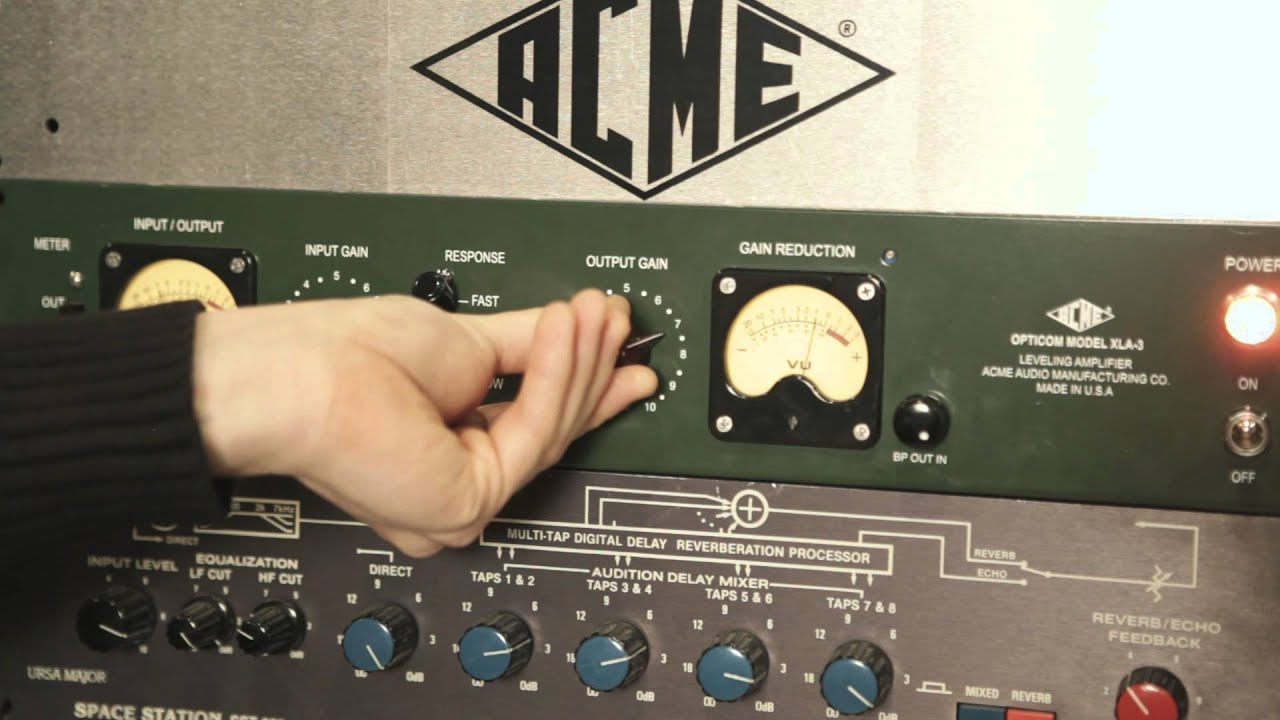
Some compressors keep things tidy. The Opticom XLA 3 does something more interesting. It brings weight, presence and movement to a signal in a way that feels rooted in real physical sound. Tubes, transformers and an optical cell work together to create compression that shapes emotion as much as level.
Where the Opticom Comes From
Acme Audio is a small American manufacturer with a strong reputation for building modern tools inspired by classic studio design. Their approach is simple: take what made vintage gear musical and dependable, then refine it with contemporary reliability. The Opticom is their flagship example of this idea.
Optical compression dates back to the early 1960s, most famously in the LA 2A. Those early units relied on a light source and a light sensitive cell to determine how the compressor reacted. Because the cell responds a little slower and more organically than a circuit driven detector, the resulting movement is smooth, musical and sympathetic to the performance. Acme kept that behaviour but pushed the tone further with a tube driven gain stage and a transformer based output.
The combination gives the Opticom its familiar thickness at low levels and its unmistakable growl when pushed.
What It Does in Practice
The Opticom reveals its personality as soon as you start driving the input. Instead of simply turning down peaks, it adds dimension and harmonic weight. The optical cell shapes the rise and fall of the performance, the tubes soften the edges, and the transformer adds warmth that feels solid rather than cloudy.
On vocals it adds presence without brittle top end. On bass it creates a controlled bloom that sits naturally in the centre of a mix. On guitars, keys and percussion it provides focus without flattening the life out of the part. It is not transparent by design, but the colour it adds feels musical rather than dressed up.
Why Engineers Reach For It
Engineers turn to optical compression when they want the compression to feel connected to the player rather than imposed on them. The slower attack and release of the optical cell mimics how human dynamics naturally move, so the effect often feels more like guiding a performance than correcting it.
This is where the Opticom stands out. It can be gentle and steady, but it also rewards being pushed. Bring the input up and the sound firms up, adding attitude and shaping the note in a way that works beautifully when you want a part to feel grounded and confident.
At Noise Machines this is usually where the Opticom enters the picture. If a vocal, bass line or guitar part needs extra substance or a sense of physical presence, the Opticom is often an early choice. It sits comfortably alongside our other outboard tools and becomes part of the overall character of the room.
Want to Hear It for Yourself
If you have not worked with a true optical tube compressor before, the Opticom is a great introduction. It adds depth, motion and tone that are difficult to recreate with software alone, and it can change how you think about shaping dynamics.
If you want to try it on your next session, reach out to radi@noisemachines.studio or call 0405 709 131.
Related Reads
- Gear Spotlight: The Fulltone Tube Tape Echo
A closer look at another analogue unit that brings depth, motion and personality to a mix.
- Noise Machines Gear List
Explore the full collection of studio gear available for your next session.