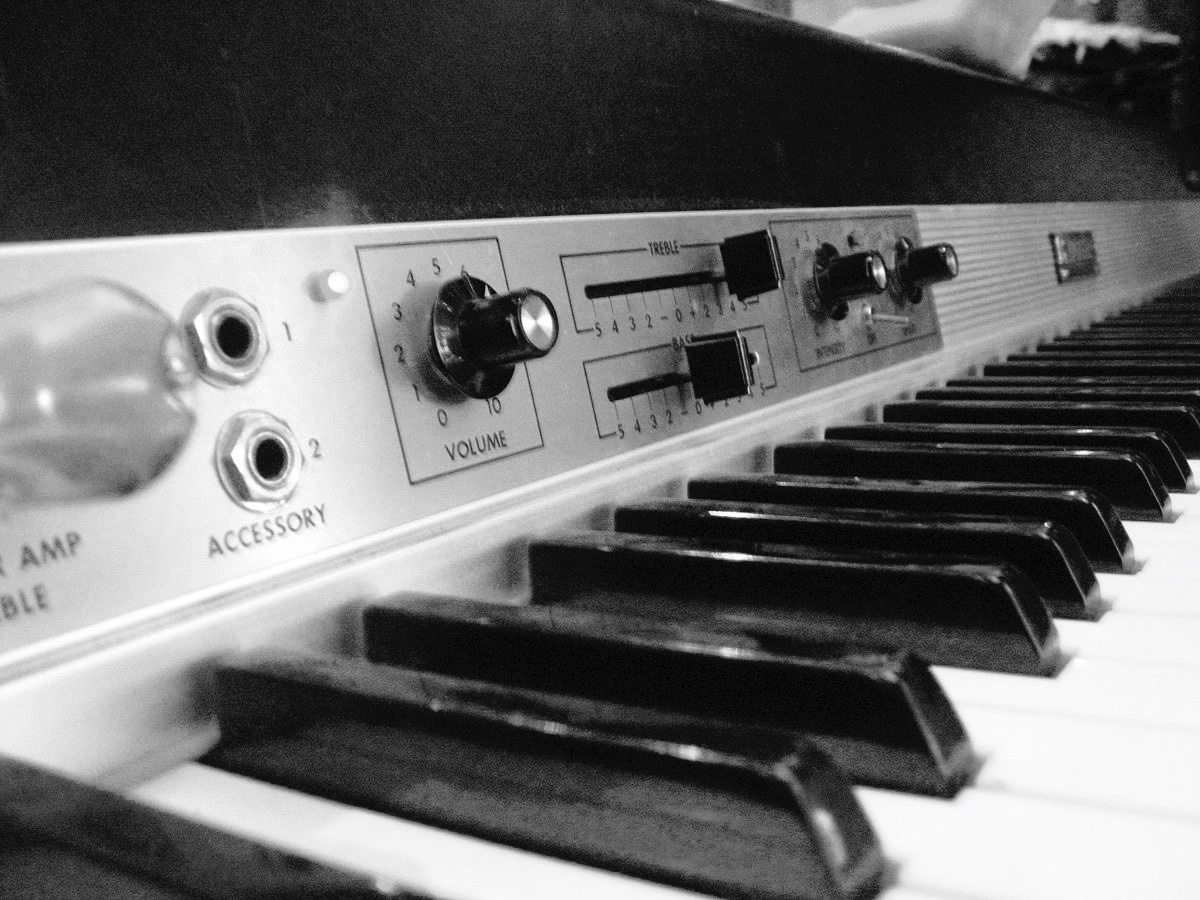
Few instruments carry the warmth and nostalgia of the Rhodes electric piano. The unmistakable chime of its tines has defined countless records across genres—from jazz and soul to rock and ambient electronica. At Noise Machines, our Rhodes Seventy-Three Mark I remains one of the most inspiring instruments in the studio—one that blurs the line between performance and production every time it’s switched on.
A Brief History of a Classic
The Rhodes story begins with Harold Rhodes, an American piano teacher and inventor who began developing his ideas during World War II. Determined to help recovering soldiers reconnect with music, he created small “lap pianos” using aircraft parts. After the war, Rhodes partnered with Leo Fender, giving birth to the first Fender Rhodes electric pianos in the 1960s.
The combination of Rhodes’ musical vision and Fender’s manufacturing expertise created a new kind of instrument—one that offered the dynamic feel of an acoustic piano, but with an electric, bell-like tone that could hold its own next to guitars and drums. By the 1970s, the Rhodes had become the keyboard of choice for touring musicians and studio players alike.
The Mark I at Noise Machines
Our Mark I Seventy-Three represents a golden era in keyboard design—73 weighted keys, a solid, compact build, and a built-in vibrato that gives everything you play a subtle, liquid shimmer. Sitting at the center of the live room, it’s as much a visual icon as it is a sonic one.
There’s a tactile quality to the real instrument that samples and plugins can’t quite capture. The slight resistance of the keys, the soft clatter of the tines, and the way the tone evolves depending on your touch—it all adds up to something deeply expressive. It’s an instrument that rewards feel over perfection.
The Sound of Generations
The Rhodes has appeared on countless landmark recordings. Herbie Hancock’s “Chameleon” turned its smooth tone into a funk powerhouse. Steely Dan’s “Peg” layered it under pristine harmonies to create a glassy, modern sheen. Later, artists like Radiohead, D’Angelo, and James Blake used it to bring warmth and depth to more experimental soundscapes.
That versatility is what makes the Rhodes so timeless—it can be subtle and supportive, or take the spotlight with just a touch of overdrive or chorus. In our sessions, we often run the Mark I through a Fender Twin Reverb for sparkle and natural compression, or straight into the desk for a punchier, more immediate tone.
Why It Still Matters
There’s no shortage of Rhodes emulations today, but nothing replaces the feeling of the real thing. The physical response of the keys, the imperfections in the tuning, the way the instrument seems to breathe with the player—it’s all part of its charm.
For producers and artists, the Rhodes brings a sense of glue to a track. It’s both grounding and ethereal, capable of filling space without ever being intrusive. Whether you’re sketching a song idea or chasing a finished sound, the Seventy-Three Mark I has a way of guiding you toward something musical.
Experience It for Yourself
Looking to add warmth and vintage soul to your next project? Come experience our Rhodes Seventy-Three Mark I in person at Noise Machines.
Get in touch with Radi at radi@noisemachines.studio or 0405 709 131 to book a session.
Related Reads
- Gear Spotlight: Fulltone Tube Tape Echo – Explore how this outboard effect unit adds warmth and character, shaping tracks with its classic tape echo tone.
- Exploring the Musical Glue in a Mix – Learn the secrets to creating cohesion and balance in your mixes through space, grouping, and arrangement.